Wednesday, November 4, 2009

Announcing RCI - Mumbai

First of all I would like to thank all my friends for the great support and enthusiasm you all had shown for "Think Spice - Think Red Chillies". Since I had not been keeping well for sometime now, I couldn't post the round-up for it in time. Will post it soon. 


Now coming to "RCI - Regional Cuisines of India" is an event started by Lakshmi Krishnan of Veggie Cuisine.  The theme for this month is the Great Mumbai.


Exotic Cuisine of Mumbai 
Indian food is as varied as India, every region and state having its characteristic dishes, and you can get them all here. 


Mumbai is one of the most popular travel destination of Western India. Mumbai is the country's most cosmopolitan city. As it is on the seashore, the cuisine of Mumbai depends heavily on fish and coconuts. 


Food simply means scrumptious dishes in Mumbai. The Chaupati Beach always reminds one of the lip-smacking 'Bhel-Puri' a fast-food made of puffed rice with lots of chillies, sauces and chopped onions. A typical Bombay platter consists of curries, rice, curd, chapattis, vegetable, salad, sweets etc. In fact, platter system is quite prevalent in the city and makes the most-preferred meal, seeing that it contains the all-inclusive diet of an individual. The traditional food of Mumbai is just awesome. Mumbai's dishes like Bombil Batata Bhaji, Kamag Kakri, Solachi Kadhi etc, are famous all over India. Here, people enjoy their own variety of fast-food, which ranges from Bhel Puri to Pav Bhaji and Vada Pav to Pani Puri. Most of these snacks are really hot and spicy, which would certainly tickle your taste-buds.


Vada Pav, the poor man's food,the hamburger of Mumbai, is a deep fried cutlet made of potatoes inside round-shaped bread.  


Bhelpuri is a sweet and spicy combination of puffed rice, onions, boiled potatoes, puri, coriander, mint, chililes and chutney.


Pav bhaji is a potpourri of cooked and spiced vegetables such as peas, peppers, tomatoes, potatoes and onions accompanied by a bread bun.


Panipuri are lightweight puffed semolina or flour cakes, eaten with a filling of boiled pulses (lentils), spices, tamarind chutney and spicy water.


Hot and Spicy Sabudana vada Crisp sago balls deep fried in oil or ghee. 


Onion Bhaji spicy onion fritters - a light snack


Sabudana Khichdi a delicious snack of sago, Maharashtrian fasting favorite.


Potato vadaspicy potato balls coated with batter of gram flour and deep fried in oil 


Kaande Poheflaked, beaten rice snack with onions and potatoes.


Vegetable sandwich filled with slices of tomato, potato and cucumber with spicy chutney.


Vatali dal Soaked and ground chana dal tastes different when cooked this way. A good substitute for breakfast or tea time snack.


Kothimbir Vadi fried squares made of coriander leaves (cilantro) and other spices


Alu vadi Spicy cakes of colocassia leaves. Also know as 'Patra'.


Bread Rolls spicy bread rolls filled with mashed potatoes and deep/shallow fried in oil.


Matar Patties patties filled with green peas and other spices.


Phodnichi Poli spicy snack made of leftover chapatti.


Bread sheera Crispy dish made of bread pieces, chilies and onions. Some Marathi people call it 'Pavacha sheera', 'Phodnicha pav','Pavacha uppama' or Pavachi usal'. Real quick and delicious snack!Mokal Bhaajani (Phodnichi Bhaajani) ingredients of Thalipeeth, but cooked in different style. 


Dahi batata puri good substitute for breakfast or mini meals during summer days.


Misal Pav as the name suggests, a spicy mixture of pulses, potatoes and other spices, easy to prepare 


Shev batata puri a light snack made of flat puris garnished with mashed potatoes, chutneys and other condiments.


Tikhat-mithachi puri a delicious spicy version of puris 


Pav bhaaji medley of variety of vegetables cooked in different style, Mumbai knows what people like!


Ghavan rice flour pancakes - a quick meal.


Sabudana Thalipeeth sago and potato pancakes


Instructions for "RCI - Mumbai" :


(a) So dear bloggers, now its time for you all to cook up some amazing Mumbai dishes in your wonderful kitchens and post it in your blog. Both vegetarian and non-vegetarian posts are welcome.


(b) Post as many Recipes as you like on your blog for this RCI - Mumbai Event this November.  


(c) Linking back to this "RCI - Mumbai" Announcement -  and to Lakshmi Krishnan's blog -  Veggie Cuisine is a must.


(d) It would also be very much appreciated if you can also include any information about Mumbai Cuisines. 


(f) Using the Logo to the event is also appreciated. (Will be up shortly)


(g) Old post’s are also accepted only if it is re-published and linked back to this announcement post and to Lakshmi Krishnan's blog -  Veggie Cuisine


(h) E-mail me to

   kitchenchronicles1(AT)gmail(dot)com with SUBJECT as "RCI - Mumbai" along with the following details..


Your Name:
Your Blog Name:
Name of the Dish: 
Link/URL of the Post: 
Attach a Picture of the Dish. Size 300 x 300 . 


(i) Deadline for all the entries will be the 5th December-2009. 


(j) You don't have a blog but want to take part in this event, it’s not at all a problem. You can send me your Recipe along with the picture of the dish to kitchenchronicles1(AT)gmail(dot)com with SUBJECT as "RCI - Mumbai". Don’t forget to mention your name and your location.

Friday, September 18, 2009

Veggie Omlet


My son and daughter like these kind of Omlets. Rather than the normal ones with just the onion or without the onion.


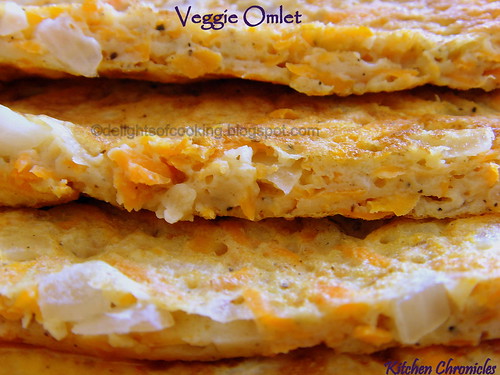
This is a very versatile omlet you can just about twist the contents based on what you have with you.


I mostly prefer to use carrots, potatoes, zucchini.


Omlet


Ingredients
Veggies (Carrot, Potatoes, zucchini, etc.) - 1/4 cup
Onion (Big) - 1
Salt to taste
Black Pepper Powder to taste
All purpose flour - 2 tb.sp
Eggs - 2 to 3
Cheese - 2 tb.sp (optional , I have not added here)


Method
Peel and grate the veggies in a fine grater. Chop the onions finely. Put eveything together in a mixing bowl. Except the eggs. I like to use homemade Pepper powder than the store brought ones. Somehow I feel something is missing in the store brought ones. You can also use green chillies if you like it. Since I mostly make it for children I avoid using green chillies. Heat a skillet to medium heat. Smear it with oil. Now add the eggs with the mixture and beat lightly. Pour a ladle of this mix on the hot skillet and spread it out slightly. Let it cook, but be careful not to let it get overcooked. Turn to the other side and again let it cook.

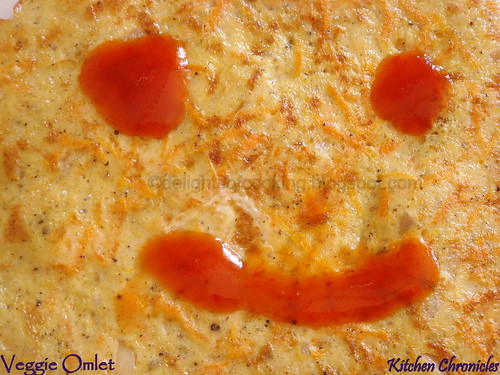
Omlet_1

I comes out very spongy and is very filling. Serve hot with tomato sauce or as a sandwich between breads. It is good as evening snacks as well as for morning breakfast.

Rushing this to Divya of Dil Se's Show me your omlet event.

Note : Adding Cheese adds to the taste a lot, but a keep a check on the salt u add. Also instead of smearing the skillet with oil you can also use butter. This also adds to the taste.

Wednesday, September 2, 2009

Chillies - Some Like it Hot

They can be red, green, orange or almost the brown colour of chocolate. They can be pointy, round, small, club-like, long, thin, globular or tapered. Their skins may be shiny, smooth or wrinkled and their walls may be thick or thin.


You guessed it - chillies!


This month's event @Kitchen Chronicles is the famous "Think Spice" event which was started by Sunita Bhuyan of Sunita's World. She does not need any introduction at all. Her blog is always a breathtaking blog with all those beautiful clicks.


So it is "Think Spice - Think Red Chillies" for September.


Chillies


The chilli pepper comes from a pod-like berry of various species of the capsicum family found in Latin America. Accidentally discovered by Columbus, these fiery little vegetables are utterly delicious and an essential part of the cuisine of many parts of the world.


To the chilli connoisseur, each type has its own distinctive flavour, and a particular variety of chilli may be used to lend a specific dish its unique taste.
There are more than 400 different varieties of chillies found all over the world. The world’s hottest chilli “Naga Jolokia” is cultivated in hilly terrain of Assam in a small town Tezpur, India. Chilli became extremely popular in India after it was first brought to India by Vasco-da-Gama. Chilli found its way in ayurveda, the traditional Indian medical system. According to ayurveda, chilli has many medicinal properties such as stimulating good digestion and endorphins, a natural pain killer to relieve pains.


Chilli is an indispensable spice used as basic ingredient in everyday cuisine all over the world. The chilli powder is made by crushing the dried chilli having chilli flakes and chilli pods. The chilli powder began to be used to different countries. Today, it is unimaginable to think of India cuisine without the hot spice, chilli.


Generally, the smaller chillies are the most pungent. Because some chilli peppers are hotter than others, it pays to know your habaneros from your poblanos and your guajillos from your jalapenos. The heat rating of chilli peppers is related to its Scoville number. The higher the number of Scoville Heat Units (SHU's) assigned to a chilli pepper, the greater will be its burn.


Most of the heat is in the seeds and the membrane, so if it's your first time trying chillies, or you don't like too much heat, discard these. The heat comes from a chemical compound called capsaicin (the active ingredient in chillies), produced within the glands of the chilli, that intensifies as it matures.


If you have braved the effects of eating fresh chillies and your mouth is burning, don't be tempted to drink water, as this can intensify the effect in the short term. Instead, have either yoghurt, sour cream, cheese, milk, cucumber or chopped mint.


Chillies are Nutritious


Chillies are a rich source of vitamin C, and a good source of niacin (vitamin B3) and beta-carotene. That is, if you can eat enough of them! One hundred grams of red chillies contain a week's supply of vitamin C, but a single chilli divided into a dinner for four makes less of a nutritional contribution. Nevertheless, chillies add loads of flavour, have virtually no fat or sodium, and are very low in calories. More than just flavour, there are some advantages of eating chillies.


Some Advantages of Eating Chillies


• It has been proposed that the eating of chillies results in the production of endorphins by the body. These are the feel-good chemicals that create a temporary feeling of euphoria.


• Chillies are reputed to aid digestion.


• The hot stimulating properties of chilli make it useful in clearing sinus passages, and it has been found to reduce mucous production in certain instances.


• Chillies appear to have some type of anti-inflammatory property. This is thought to be linked to their ability to cut recovery time of colds and flu, when taken liberally in the early stages of these ailments.


• Research originating in Thailand has found that people who eat a diet high in red peppers experience a  much lower incidence of blood clotting.


• Scientists have now concluded that chilli does indeed possess fibrinolytic activity, meaning that it is able to break down blood clots.


• Chillies are also thought to help buffer pain from ailments such as arthritis, headaches and menstrual cramps.


• It has been postulated that a high daily intake of chillies may improve circulation to the hands and feet, in those suffering from poor circulation.


• Other responses of the body to eating chilli include increasing salivation in order to try and refresh the mouth, and an increased rate of sweating.


Information Source :


Instructions for "Think Spice - Think Red Chillies" :

(a) Post any dish featuring Red Chilli as the main spice. Red Chilli can be used in any form (finely powdered, freshly ground or whole) and any variety of Red Chilli can be used. Both vegetarian and non-vegetarian posts are welcome.


(b) Post as many Recipes of Red Chillies as you like on your blog this September 2009. The more the better.


(c) Linking back to this "Think Spice - Think Red Chillies" Announcement -  and to Sunita's bloghttp://sunitabhuyan.com/?page_id=341 is a must.


(d) It would also be very much appreciated if you can also include any information about Red Chillies.


(f) Using the Logo to the event is also appreciated. (Will be up shortly)
 (g) Old post’s are also accepted only if it is re-published and linked back to this announcement post and to Sunita's blog - http://sunitabhuyan.com/?page_id=341.


(h) E-mail me to kitchenchronicles1(AT)gmail(dot)com with SUBJECT as Think Spice - Think Red Chillies" along with the following details..


Your Name:
Your Blog Name:
Name of the Dish:
Link/URL of the Post:
Attach a Picture of the Dish. Size 300 x 300 .


(i) Deadline for all the entries will be the 1st October-2009.


(j) You don't have a blog but want to take part in this event, it’s not at all a problem. You can send me your Recipe along with the picture of the dish to kitchenchronicles1(AT)gmail(dot)com with SUBJECT as "Think Spice - Think Red Chillies". Don’t forget to mention your name and your location.

And also please remember to rush in your entries for A.W.E.D German going on here. 3 more days left.

Tuesday, September 1, 2009

German Foods - Ricotta Cheesecake From My Oma

Since Oma (Mrs. Ute Wieland) doesn't have a blog, she mailed me the recipe for participating in the event A.W.E.D German. I would like to share it with all of you.

Here I would also like to share some few words about her and Opa. Well what is Oma and Opa? It means "Grandmother and Grandfather" in German. They were the German Opa and Oma of my children.  I met them 6 months after we had been in Germany. She was very fond of us and our family. We used live in 1st floor above them. She made us all feel at home. And slowly we all became very close. During the 2 and 1/2 yr we spent with them she had with us during all times (happy and sad). They had been a great support to us in a foreign land.

We used get Salads and fruits everyday in the evening. My children used to get some sweet things from her everyday. She introduced and taught us to like German Food. They were part of our life.
Back at home now we miss them a lot.

Though she is not so very fond of sweets but still since I like cakes and sweets she has send me these recipes for the event.

Her recipe for Ricotta Cheesecake and Rhubarb Compote.


Ricotta_Chesscake

Ricotta-Cheesecake
Ingredients:
For 10 pices
500 g meager Quark
500 g Ricotta
6 eggs (small or medium)
200 g sugar
4 dessert spoons food thickness salt
1 dessert spoon rubbed off Bio lemon peel
1 dessert spoon smooth butter
50 g desiccated coconut
100 g bilberries
100 g raspberries
150 g strawberries
4 dessert spoons icing sugar
maybe fruit compote

Preparation (approx. 60 minutes + chilling time)

1st Quark, Ricotta, eggs, sugar, thickness, 1 pinch of salt and lemon peels with the whisk to a smooth mass stir.

2nd Cover a baking tin on the ground (26 cm diameter) with baking parchment.
Ground and edge with butter and disperse with desiccated coconut. Fill the Quark mass.
Pick the berries, those strawberries cut to quarters and distribute over the mass together.

3rd In the hot oven at 175 degrees (circulating air 160 degrees) on the lower level, bake 40-45 minutes. On a rust, let the baking tin cool down.

This is going to A.W.E.D German hosted by me and started by DK of Chef In You.

Monday, August 31, 2009

Modak and Nugul-untallu(Sesame Laddoo) - Ganesh Chaturthi 2009

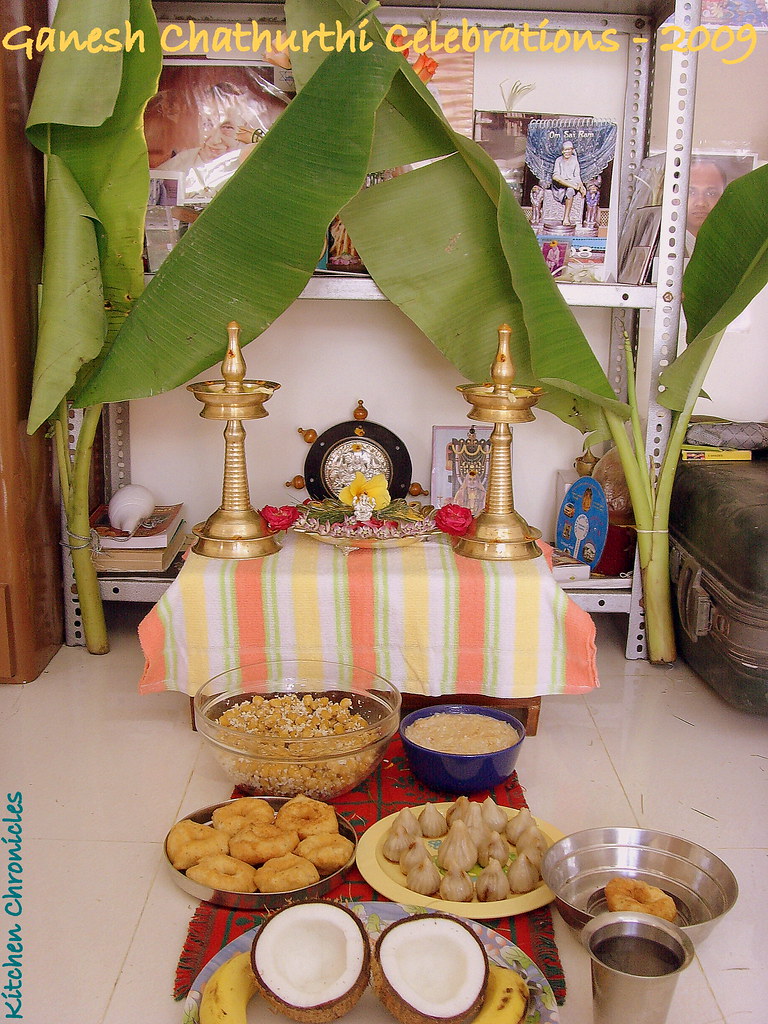
This years Ganesh Chaturthi was grand for us. After 3 yrs in Munich, this year was the 1st Ganesh Chathurthi after coming back. So I liked it very much. I got all what I wanted to make and do things.

I always make typical Tamil Nadu style modakam for ganesh Chathurthi. But since it was this months challenge in Indian Cooking Challenge to try other state specials for Ganesh Chathurthi I made Modak and Boorelu (Sesame Laddoo). Both of them came out very well. And before I could take a close up photo of the Modaks it had vanished.

Krishnajayanti and Pillayar Chathurti 095
Recipe for Modak

Stuffing -
2 cups freshly grated coconut (can use frozen unsweetened coconut)

1 cup jaggery (grated)

1 tbsp poppy seeds

1 tsp cardamom powder

one pinch nutmeg (optional)

2 tbsp water (mom uses milk)


Cover -
1 cup rice flour

1.25 cup water

pinch of salt

1 tbsp oil


Preparation for Stuffing -

Roast poppy seeds in a small skillet and let it cool down. Grind it coarsely and keep it aside.

In a heavy bottom kadhai mix all the ingredients for stuffing except poppy seed powder and let it sit for 15 min. Now start heating the mixture over medium heat. In about 10-12 minutes, the mixture starts boiling and stuffing will turn yellowish brown and will be sticky. Take the kadhai off the heat, add poppy seeds powder and mix well. Set it aside to cool down.

Preparation for cover -

Take vessel that has tight fitting cover. Start boiling water in that vessel, add salt and oil. When water starts boiling, lower the heat and slowely add rice flour. Please do now dump everything at once. Start mixing vigourously with a heavy spoon. Now close the lid and take the pot off the heat. Let the covered pot cool down for 15 minutes or so. Then with wet hands, mix the dough properly. It will warm so be careful and use cold water to keep your hands from burning but do not use too much water. if you think the dough is little sticky, I will suggest add 1-2 tbsp maida to it and make the dough.


Making Modak (Final Product) -

Start boiling water in a large vessel that can fit a steamer. I use a stainless steel steamer that fits on a pressure cooker and water doesnt touch the steamer and use stainless steel plate to cover it. Oil the steamer and set it aside.

Make about 20 balls of the dough and 20 parts of the stuffing. Start making small puri with the dough ball on a oiled paper/aluminum foil. Keep one part of stuffing in the middle of the puri and gather the puri gently to make shape like modak. You can see the picture here - http://www.hotelshreyas.in/photo/modak.jpg. You will have to handle the dough very gently. Follow the step to make remaining modaks. Now dip each modak in cold water and put it in the steamer. Put the steamer on boiling water and cover it. Let the modaks steam for 20 minutes on medium to high heat. Take the steamer off the vessel and let it sit for 5 minutes before removing moodak from steamer.


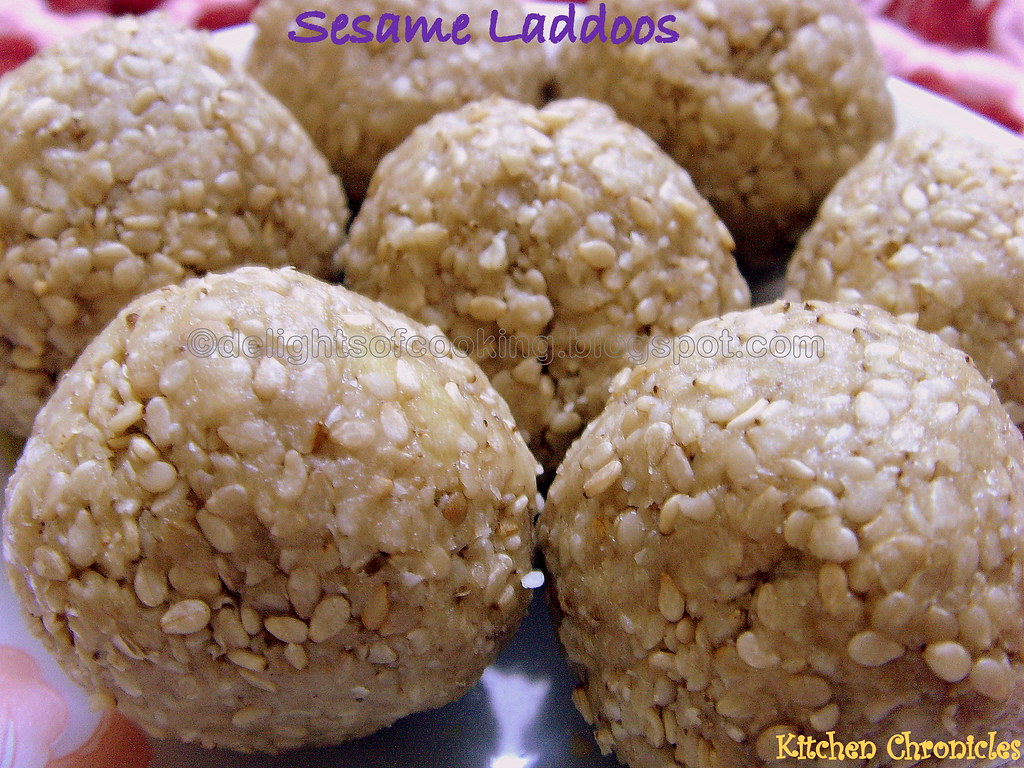
Recipe for Nugul-untallu (Sesame Laddoos)
Krishnajayanti and Pillayar Chathurti 143

Dry roast sesame in a tawa and let them cool. Once they are cool, take about 2 - 3tbsp of grated or powdered jaggary and run in a mixie. The amount of jaggary normally depends on the formation of laddoo. When you make a laddoo, it should stay in shape. Then you know the amount is enough. Also it depends on the fineness of the sesame powder. When you run in mixie, it becomes little oily which will help in holding the laddo shape.

For about 100 gms of Sesame seeds, I must've used some 3 tbsp of Jaggery. This should easily stay for a week, but I have known it to happen as it never stays that long at home! I got around 12 -15 laddoos with the size I made.

The recipe called for black sesame seeds, but since I had only the white ones, I used them. And as srivalli said it tastes out of the world.

Reposting for the event - State Specials & CFK - Evening Snacks

I am reposting some of my old posts for the event State Specials hosted by Shanti of Shanti Krishnakumar's cookbook. And for Cooking for kids - Evening Snacks event hosted by Divya of Dil Se. Both are traditional chettinad recipes.


Saturday, August 22, 2009

A.W.E.D German

I am reposting my old posts for A.W.E.D German going on here in my blog.

Just 12 more days to go. Please send in your entries soon. You can find more details here.


My very 1st post in this blog is Zuchinni Platzchen.
Zucchini Platzchen - Recipe

Then comes Vanille Kipferl

Vanille Kipferl - Recipe
Now comes Sour Cream Cucumberr Salad. Sorry about the click. This was one of my Oma's special salad.
Sour Cream Cucumber Salad - Recipe
Then comes sweet All time favourite Black Forest Cake
Black Forest Cake - Recipe
And comes again in the line is one more salad from my Oma
German Feld Salad - Recipe

Sunday, August 9, 2009

Toast Sandwich

I used to go with my father to his Nariman Point office in Bombay sometimes. His usual lunch was this Toast Sandwich and a plate of fruit salad. I also used to enjoy it. As it is I am a big fan of Bread Toasts. So it used to be my favourite.

I used to study the Toast Sandwich which we bought for lunch and tried making it at home. The first time itself it became a great hit. So this toast sandwich has always been a winning dish from then on. It is versatile and you can change or add any of the ingredients as you like.


Ingredients

Carrot – 1 Half cooked & cut into rings

Beetroot – 1 Half Cooked & cut into rings

Potato – 1 Half Cooked & cut into rings

Bell Pepper – 1 (cut into rings)

Cucumber – 1 ( Cut into Slices )

Onion – 2 ( Cut into Slices )

Green Chutney or Tomato Chutney or Hot tomato sauce – ½ cup

Bread Slices – 16 to 18 slices

Butter (softened)

Method

Heat the sandwich toaster. Apply butter on one side of the bread slices. And apply the chutney of your choice on the other side. Place the bread slice with the butter side touching the toaster. Place the pieces of veg layer by layer. Close with another slice of bread. And now close the toaster. Let it cook for some time.

And thats it Tasty Veg. Toast Sandwich is ready. Serve it just like that or with sauce.

This Veg. Toast Sandwich is going to Divya of Dil Se's Show me you sandwich event.

Saturday, August 1, 2009

A.W.E.D German Event Announcement

A.W.E.D (A Worldly Epicurean's Delight), has arrived here this month. A.W.E.D is an event started by dear DK of Chef In You. I thank dear DK for this opportunity.


Now let us take a look at what we are planning for this month. I had lived in Germany, Munich for three years. I loved the place, the people, the country and ofcourse the food. I had a very wonderful neighbor Mrs. Ute Wieland who taught me many German Dishes, German Language and so on. So I am hosting A.W.E.D German this month as a way of thanking her and the country.

There is no one way to define German food. The cuisine is as diverse as the country itself - with each region having its own specialties. We can say, however, that German food is very tasty; it is rich in tradition and history; and it can satisfy even the most discriminating of palates. German cooking is full of inspiring, European flavors, ingredients and cream, lots of cream.

Essen und Trinken hält Leib und Seele zusammen.

(deutsches Sprichwort)

----

Food and drink hold the body and soul together.

(traditional German saying)


“Typical German cuisine”


Germany is renowned for its heavy, substantial regional cuisine - you should really give them a try. Typical examples include Roast pork with dumplings from Bavaria, "Rheinischer Sauerbraten" (beef marinated in red wine vinegar, served with dumplings), ribs and sauerkraut or "Himmel un Äd" meaning Heaven and Earth. This dish is made of black pudding, potatoes and apple sauce.


International influence


Dishes like these have strong traditional regional roots, but German food is more varied than you might think. Germans like to travel troughout the world. This adventurous side has left its mark and has dramatically changed culinary life over the past 50 years. In fact, the Germans are among those with the most international range of food in Europe.


The seven million foreigners who live here and who have brought their foods with them have made important contributions to this development. Practically each and every cuisine is represented: Asian and Mediterranean, Turkish and African, Thai, Chinese, Indian and Vietnamese, Greek, Spanish and Moroccan. And Italian, to name but a few.


Organic food


Another major change came with the "organic" movement (which Germans call Öko). Suddenly, people were fascinated with growing their own food. Organic foods can be found almost everywhere, now. And, what's more, this fascination inspired more men to cook and so discover the kitchen!


Breakfast

German breakfast habits are much the same as in other countries. A good, traditional breakfast includes bread, toast, and/or bread rolls, marmalade, honey, eggs, cold meats, such as ham and salami, various cheeses, all washed down with a strong cup or pot of tea or coffee.


However, with today's busy lifestyles there is a growing trend towards eating a more simple breakfast. Today, you are more likely to see people eating cereals rather than a hearty meal of bread, cheese and sausage. Nevertheless, on the weekend the family has more time for a traditional breakfast of breads accompanied by a cheese or meat selection.


Lunch

Traditionally, Germans eat their main meal during the day, between 12 and 2 p.m. However, today, the midday meal is often eaten away from home, i.e. at work. With the increase in health and weight consciousness, lunches are becoming more light, and sometimes are nothing more than a snack.


Dinner


This is the main meal today, usually eaten at home with the family in the evening. Traditionally, the German dinner – called “Abendbrot”, meaning "evening bread", consists of a selection of whole grain bread, deli meats and sausages, cheese and a cold or warm drink. Yet, eating habits changed over time and today, many families eat the warm meal in the evening.


Pork, beef, and poultry dishes are the favourite main courses. But here too, change is in progress. Seafood used to be the domain of the northern coastal areas. But seawater fish like fresh herring, mackerel, salmon and sardines or freshwater fish like trout, salmon, bream and carp are popular across the country today.


Side dishes

Germans have always liked their side dishes. Noodles, potatoes and dumplings in all forms are very common - especially in the south. A wide variety of vegetables can be found nationwide. Vegetables are often eaten in stews or vegetable soups. Carrots, turnips, spinach, peas, beans and many types of cabbage are very common. Fried onions are a common addition to many meat dishes throughout the country. Potatoes, while a mojar part of the diet, are usually not counted among vegetables by Germans. Asparagus, especially white asparagus known as Spargel, is particularly enjoyed in Germany as a side dish or as a main meal. Many towns and cities have farmer's markets where you can buy fresh fruit and vegetables, as well as meats, fish and much more.

The other kind of side dish noodles are usually thicker than Italian Pasta. Especially in the south-western part of the country, the predominant variety of noodles is Spaetzle which contains a very large amount of yolk.


German bread

German bread is famous all over the world. German bakers and patisseries are popular in many countries. A German baker can be found from Sydney to New York, from London to Tokyo, from Johannesburg to Rio. Bread is fundamental to the German food and is known in many countries. It is darker and some kinds are baked with wholemeal and whole seeds. The traditional evening meal used to be a couple of slices of bread, some cold meat, cheese and a cold or warm drink. And bread was the staple diet.


Coffee and Cake


Kaffee und Kuchen literally means "Coffee and Cake" and is very similar to the English "Teatime". Germany is also renowned for its wide variety of cakes, often including fresh fruit. "Quarkkuchen" (Cheesecake) and "Schwarzwälder Kirschtorte" (Black Forest Gateaux) are very popular. Usually the cakes and pastries are accompanied by a steaming hot cup of coffee or tea.


Instructions for the A.W.E.D - German:


(a) Prepare a Dish that is a Vegetarian[Egg’s are allowed].Non-Vegetarian not allowed.


(b) Post as many German Dishes with Recipes as you like on your blog this August 2009. The more the better.


(c) Linking back to this A.W.E.D German Announcement and to DK's blog is a must.


(d) It would also be very much appreciated if you can also include more information about Germany.


(f) Using the Logo to the event is also appreciated.


(g) Old post’s are also accepted only if it is re-published and linked back to this announcement post and to DK's blog.


(h) E-mail me to kitchenchronicles1(AT)gmail(dot)com with SUBJECT as A.W.E.D - German along with the following details..


Your Name:
Your Blog Name:
Name of the Dish:
Link/URL of the Post:
Attach a Picture of the Dish. Size 300 x 300 .


(i) Deadline for all the entries will be the 5’th of September-2009.


(j) You don't have a blog but want to take part in this event, it’s not at all a problem. You can send me your Recipe along with the picture of the dish to kitchenchronicles1(AT)gmail(dot)com with SUBJECT as A.W.E.D - German. Don’t forget to mention your name and your location.

For German Cuisine:

http://www.knowledgehound.com/topics/germanre.htm
http://germanfood.about.com/
http://www.buzzle.com/articles/german-foods/
http://www.sallybernstein.com/food/cuisines/germany.htm

Sources same as above

Do remember to send your entries to A.W.E.D Britain being hosted by Simran at Bombay Foodie. Last few days remaining.

Thursday, July 30, 2009

Khaman Dhokla - Indian Cooking Challenge for July

Wow! This was a real challenge for me. I am not able to find time nowadays. Specially with the great support of my comp which gives so many problems everyday, and with my children's school I am find very little time for blogging.

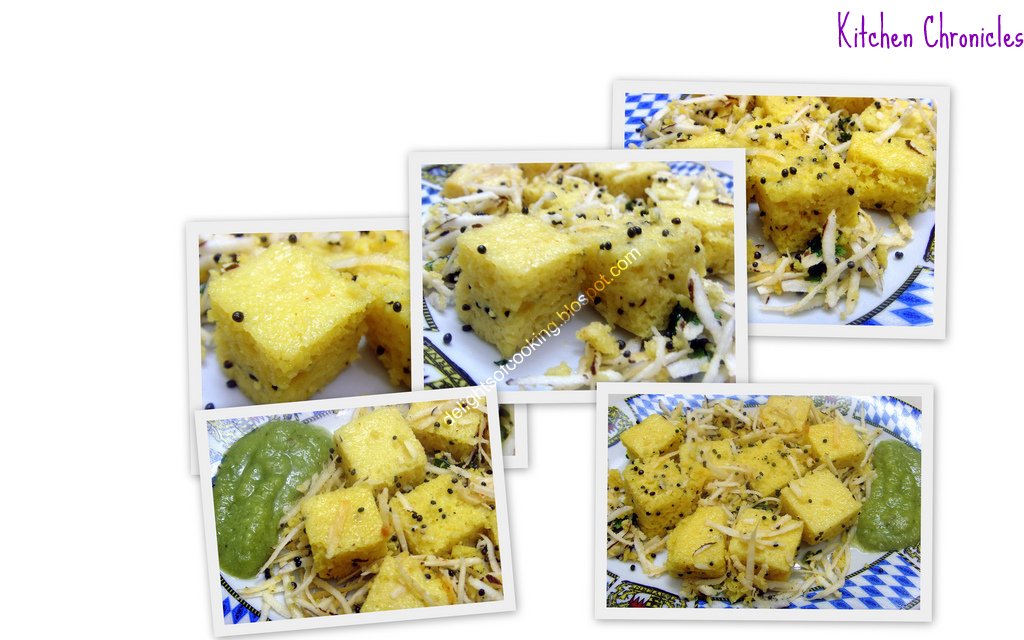
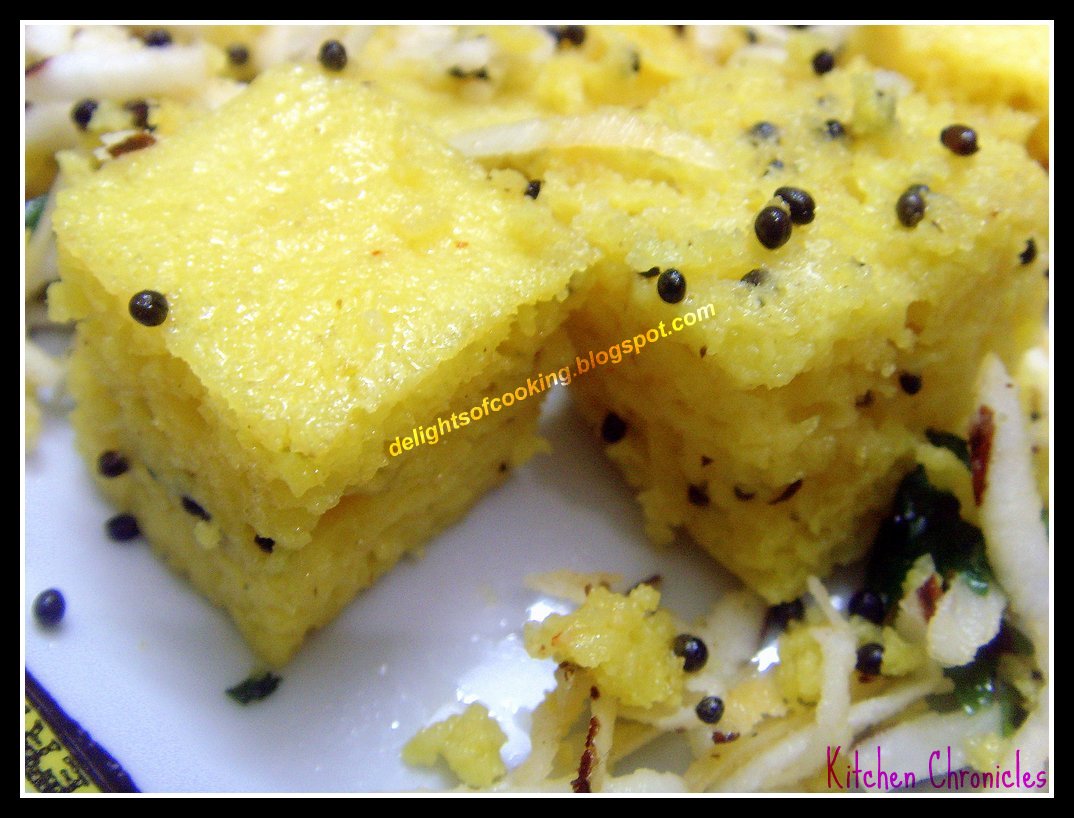
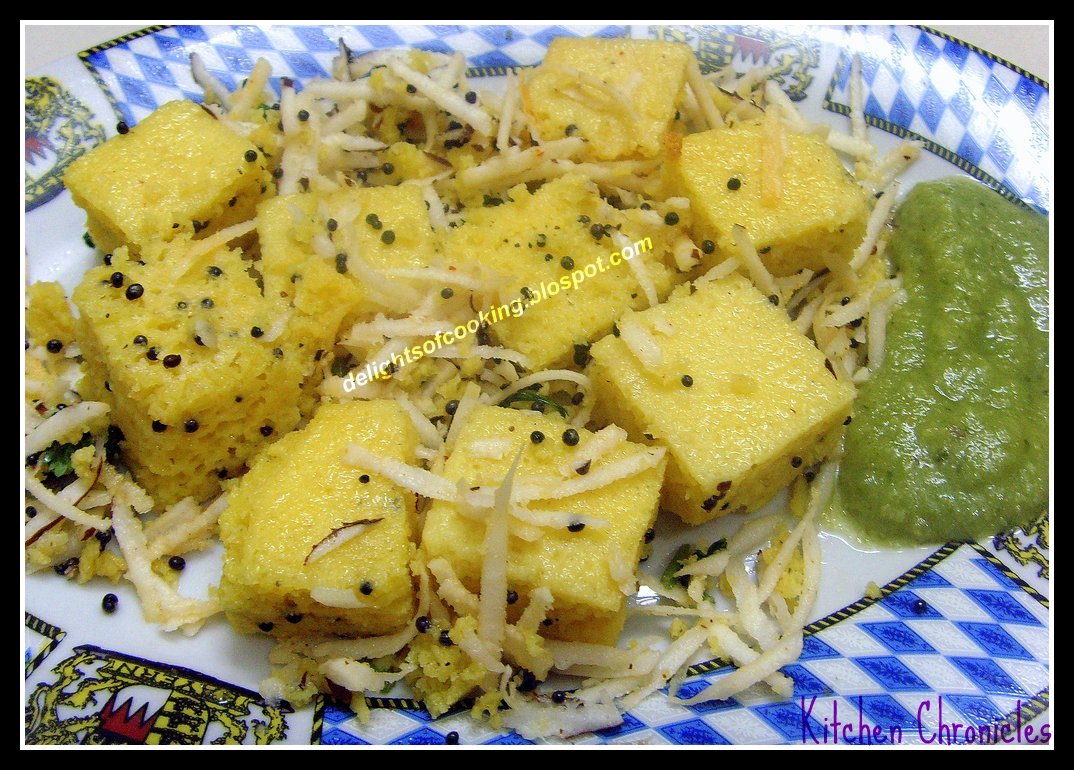
This month Srivalli of Spicing your Life chose Khaman Dhokla a Gujarathi Dish for Indian Cooking Challenge. I enjoyed making it and I took the help of my neighbour also. It came out excellent and very spongy.

So here goes the recipe for Khaman Dhokla.

Khaman Dhokla Collage

Recipe for Khaman Dhokla

For Batter:

Bengal Gram flour / Besan - 250 gms (1 & 1/2 cup)
Curd - 1/2 cup (not very sour)
Water - 1/2 cup
Cooking Soda - 1/2 tsp

For seasoning to be mixed to the batter (to be added just before cooking)
Oil - 1 tbsp
Turmeric a pinch
G. Chili paste - 1 - 2 long (as per taste)
Sugar - 1 tsp
Citric acid - quarter tsp

Eno - 1 packet (green colour fruit lime) + sprinkle or dust few bits on the plate

For tempering

Sesame seeds
Mustard Seeds
Curry leaves
Grated coconut
Coriander leaves

Little water + Oil to be topped on dhoklas

Method to prepare:

Mix first 1/2 cup curds with 1/2 water. To this add the besan and mix well to get a lump less batter, the consistency should be of idli batter, more of dropping not pouring consistency. Slowly add more water if needed else, add the soda. Keep it aside to rise for 1 hour.

If you are using a pressure cooker, fill the pan with water, place a slightly high plate over which you will have use a plate for steaming the dhoklas. Thali plate can be used for steaming. (Note: Take a plate that is little high so that there is place for the batter to rise.)

To the batter mix in the citric acid, oil, salt, sugar, green chili paste and turmeric powder. Mix well. This has to be done just before pouring to the plate. And divide the batter into batches.

Meanwhile have the pan on stove with the slightly greased plate inside it, and let the water start boiling. When the water reaches the rolling stage, you can mix the eno to the batter (Save little of eno for dusting on the plate), mix gently, you will see bubbles coming out. (Note: Add eno every time just before you are going to steam a batch of batter.) Pour batter just about 1/2 the height of the plate, so that there is place for it to rise.

Dust or sprinkle the plate with eno. Then immediately pour the batter to the plate. Place the plate carefully inside the pressure pan and cover with lid. You need not use the whistle. After covering you will find steam coming out of the outlet, simmer and don't disturb for almost 5 -7 minutes.

After 5 -7 minutes, remove the lid and proof it using toothpick or knife. If the knife comes out clean and does not have any batter sticking, then its done. Cover back and let it remain on flame for 1 min and switch off the gas and allow it for 5 minutes.

In a bowl, mix 3 tsp of water along with a tsp of oil
Remove the plate from the pan, pour the water and oil mix over the top.

For seasoning, heat a pan with oil, add curry leaves, sesame seeds, mustard seeds and finely chopped green chilies. When mustard starts popping, remove and pour over the dhokla

Let it cool for a while. If you want perfect shaped ones and not the crumbling, cut and handle gently


Green chutney

G. chili - 4-5 no
coconut - 4- 5 pieces
coriander - bunch
few mint leaves
Cumin seeds - 1/2 tsp
Lime -1 big
Salt to taste

Take all the ingredients except coriander in a food processor. Grind to a smooth paste.

Then add the coriander and again grind. Remove to a bowl, add the remaining lime and serve with Dhoklas.

Khaman Dhokla 300

Khaman Dhokla 294

This plate of Khaman Dhokla is being served to all of you by the Indian Cooking Challenge Team.

Sheermal

Sheermal or Shirmal is a saffron-flavored slightly sweet traditional leavened flatbread that is found in various countries on the Asian sub...